Mosses
November is for moss
When everything else in the fields has gone brown, the walls turn green. A wet-weather post about mosses at their best.
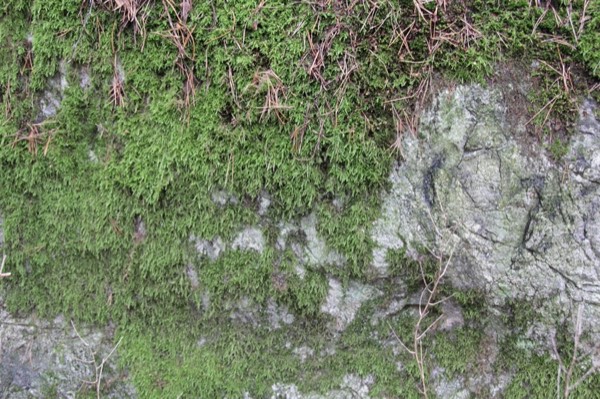
There is a week or two in November, after the leaves are down and before the first hard frosts, when the walls are the greenest things in the landscape. The fields have gone tawny, the bracken is the colour of rust, the trees are bare, and the walls are suddenly vivid: thick cushions on the copes, glossy mats on the faces, fresh capsules starting to push up on their stalks. Mosses do much of their growing in the cool, wet half of the year, and November is when you notice.
This post is less about identification and more about looking.
Why wet matters
Mosses have no roots in the way flowering plants do, and no waxy skin to keep water in. They take up water over their whole surface, and when the air dries, they dry with it. Many wall mosses can dry out completely, to a crisp, and survive for weeks or months in that state, then revive within minutes when it rains. In summer they spend a lot of time switched off. In November they are wet almost continuously, and they grow.
You can see this happen on a single walk. On a bright morning after a dry spell, the cushions on a south-facing cope are grey and tight. Then a shower comes over, and by the time it has passed, the same cushions have opened out, gone a soft green, and their leaves have spread like the petals of a small flower. If you carry a water bottle you can do it yourself, a few drops at a time.
A few to look for now
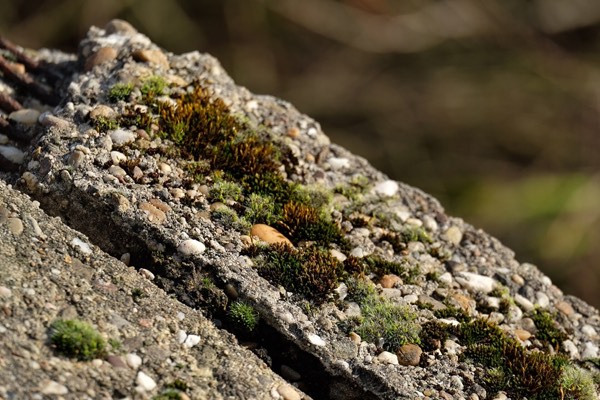
The cushions on the copes are mostly Grimmia, which I wrote about in March, and in November you can sometimes see new capsules forming on their curved stalks, tucked into the cushion. On walls in more sheltered places there are other cushion-formers I am still learning, some of them tall and loose rather than neat and round.
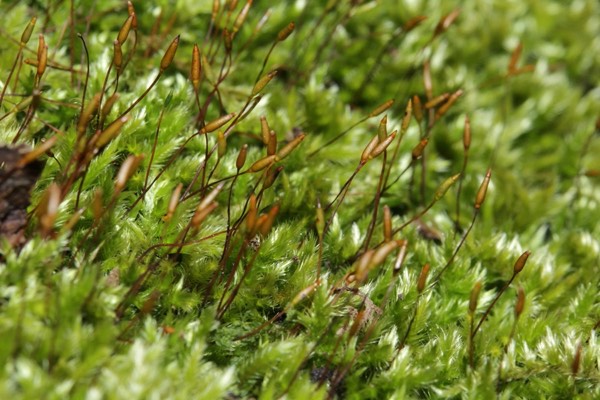
On the faces, the feather-mosses are at their glossiest. The silky wall feather-moss on my practice wall has spread perhaps a hand’s width since spring. Near the woods, where the walls are shaded, there are deep green, flat, interwoven mats that I believe are mostly Hypnum cupressiforme, the cypress-leaved plait-moss, so called because the leaves are curved and overlap like a plait. It grows on almost everything: tree trunks, logs, roofs, walls. It is one of those species that is easy to name to a group and hard to name exactly, because it has several varieties that some people treat as separate species.
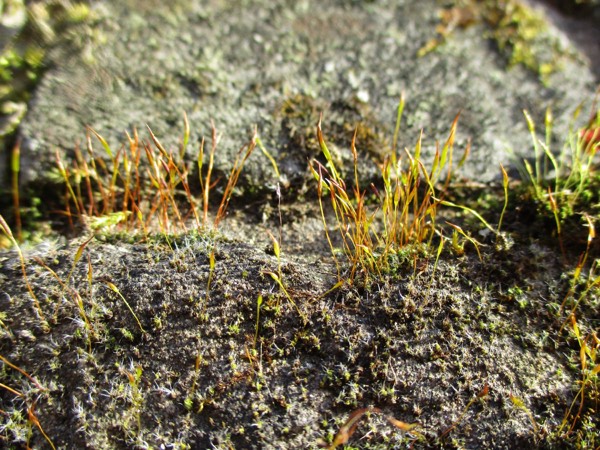
And in the joints there are the small, upright tufts with tiny capsules on red stalks that make the wall look as if it has a faint reddish haze when the light is low. With a lens, these turn out to be several different things. Without one, they are just lovely.
Things I did on a wet Saturday
- Walked my forty paces of practice wall in steady drizzle with a lens and a tea towel to wipe it.
- Found a capsule of the wall screw-moss with its twisted teeth, open, after looking for one for most of a year.
- Watched a robin pick through a moss cushion on a cope, flicking bits of it away, presumably after insects. Several cushions had been pulled apart along the wall, which I had previously blamed on people.
- Got very wet. Went home and drank a lot of tea.
A thought on slowness
Moss cushions grow slowly, and an old one may have been building up for many years. A cushion the size of a fist on a cope stone might be older than some of the people who walk past it. The walls give mosses something that is rare in a farmed landscape: a surface that nobody ploughs, mows, sprays or grazes. As long as the wall stands, the cushion can keep growing. When the wall falls, the cushion goes too, buried or turned upside down, and it starts again from spores on whatever stone ends up on top.
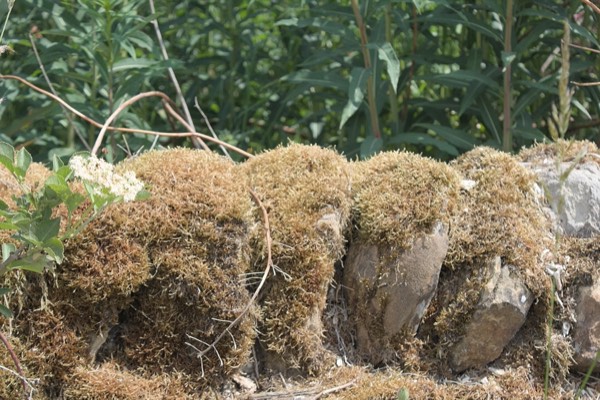
That is one argument for repairing walls rather than replacing them with fences, though I accept it is not the argument that persuades farmers. The cost of a waller per metre is the argument that persuades farmers, and it usually persuades them in the other direction.
A plan for next year
The natural history group has half promised a moss walk for beginners next November, led by someone who actually knows what they are looking at. I have volunteered to provide tea and a long wall. The wall, at least, I can guarantee.