Ferns & wall plants
A garden in a wall
Navelwort, ivy-leaved toadflax, stonecrop, herb Robert and the tiny rue-leaved saxifrage: flowering plants that make a living in the joints of walls.
Ferns and mosses are the long-term residents of a wall, but every spring a few flowering plants move in as well, or wake up after the winter, and for a couple of months some walls look more like rockeries than boundaries. Most of them are on walls near villages and roads, where there is more lime, more dust and more disturbance than on the open fell. Here are the ones I look for, roughly in the order they appear.
Rue-leaved saxifrage
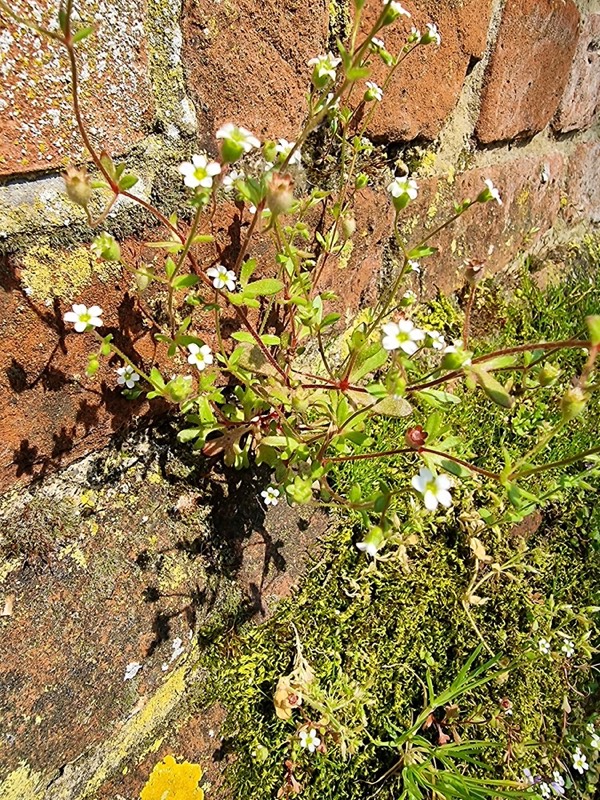
The earliest, and the easiest to miss. Saxifraga tridactylites is a tiny annual, often no taller than a finger, with small three-lobed leaves and stems that turn red in the sun. In late March and April it flowers with minute white five-petalled flowers, and then it sets seed and dies, all before most other plants have properly started. It grows on the tops of walls and in thin soil on rock, often among moss. You have to be almost on your knees to see it, but once you have found one you will find a whole line of them along the same cope.
Navelwort
Umbilicus rupestris, also called wall pennywort, is the plant I would choose to stand for western walls. The leaves are round, fleshy, a little like a coin, with a dimple in the middle where the stalk attaches underneath, which is the “navel”. In late spring and early summer it sends up a spike of small, pale, greenish-white tubular flowers.
It is a plant of the west: common on walls and rocks in Cornwall, Wales and western Scotland, and much rarer on the drier eastern side of the country. On my own walls it is scarce, and I know only one stretch where it grows, on a shaded wall near a stream. On the trip west that I described in January it was everywhere, on every bank and wall, and I kept stopping to look at it in the way that visitors stop to look at things the locals have stopped seeing.
Ivy-leaved toadflax
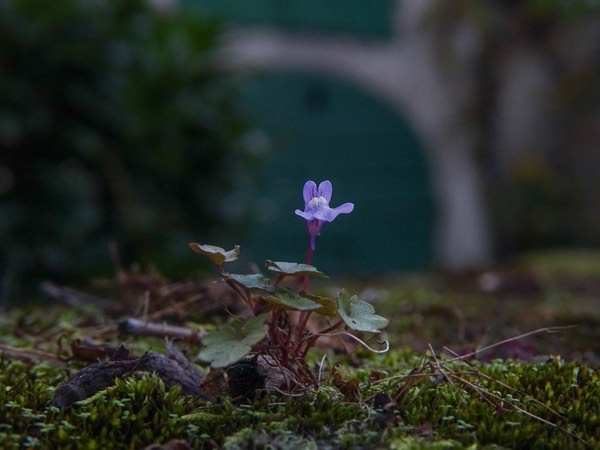
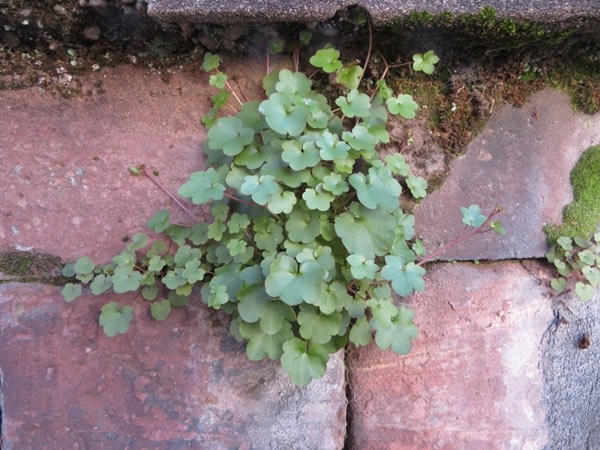
Cymbalaria muralis is a trailing plant with small, ivy-shaped, slightly fleshy leaves and little lilac flowers with a yellow spot, like miniature snapdragons. It was introduced to Britain as a garden plant, a few centuries ago, and has spread onto old walls all over the country, especially mortared ones.
The detail everyone mentions, and quite right too, is what it does with its seeds. When the flower is young, its stalk grows towards the light, holding the flower out from the wall. Once it has been pollinated, the stalk turns and grows away from the light, back towards the wall, pushing the developing seed capsule into a crack or crevice. The plant plants its own seeds. I have checked this on the wall by the church, and it is true: the old flower stalks are all bent back into the joints.
Stonecrop
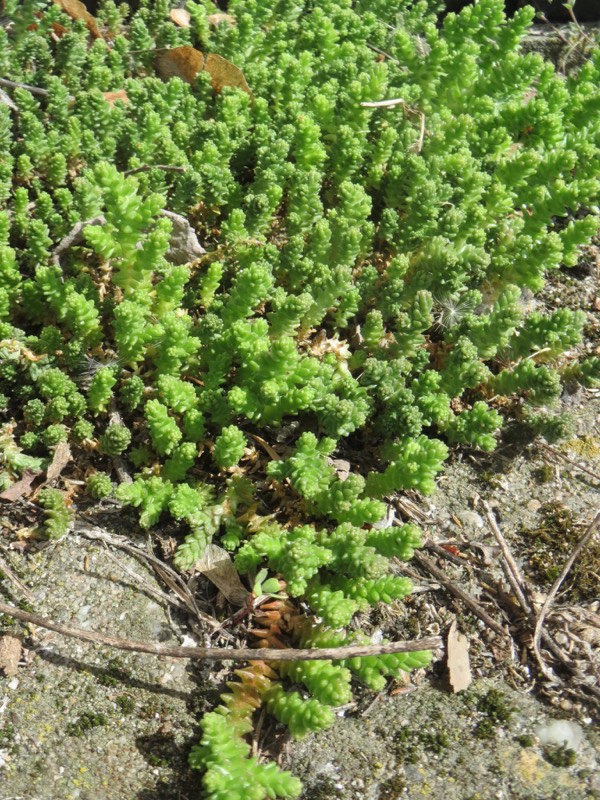
Biting stonecrop, Sedum acre, makes low mats of tiny, fat, pale green leaves on the tops of walls and on old roofs, and in early summer it covers itself in bright yellow star-shaped flowers. The leaves store water, like a cactus, which is how it survives on a sunny wall top. The name comes from the peppery taste of the leaves, which I am told about but have not tried and do not recommend, as it is mildly toxic.
Herb Robert and fairy foxglove
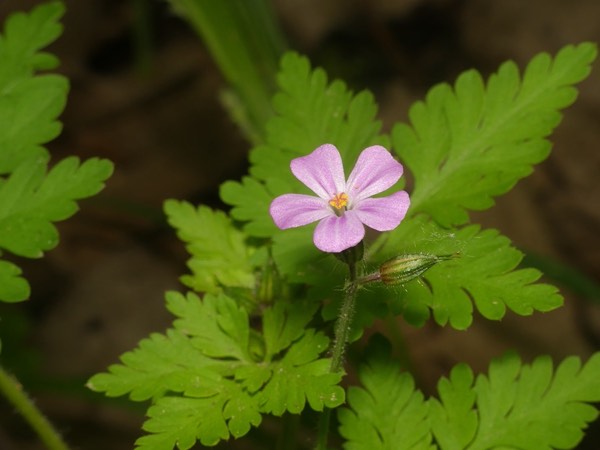
Two more, both common. Herb Robert, Geranium robertianum, is a small wild geranium with feathery, reddish leaves and pink flowers, growing at the bottom of shaded walls and in their lower joints. It has a strong smell if you crush the leaves, which some people find unpleasant and others find oddly comforting. I am in the second group.
Fairy foxglove, Erinus alpinus, is another introduced plant, from the mountains of southern Europe, that has escaped from gardens onto walls in many places. It makes small tufts of toothed leaves with clusters of purple-pink flowers in late spring, and it is especially fond of limestone. There is a wall in a village I sometimes visit that is so covered in it in May that it looks as if someone had painted the joints.
A thought about weeding
Some people pull all of these out of walls, on the grounds that roots split stone. For big woody plants like ash or sycamore seedlings, that is fair; a tree in a wall will eventually push it apart. For the small plants in this post, I do not believe the damage is worth worrying about, and they are a large part of what makes an old wall worth looking at. Please leave the toadflax alone.